

Estate Argyros: Old Vines and the Volcanic Soul of Santorini
Few wineries embody the extraordinary landscape of Santorini as completely as Estate Argyros.
Established in 1903, the estate has been producing wine for more than 120 years, although the Argyros family’s connection to viticulture and winemaking began generations earlier. Today, Estate Argyros is led by fourth-generation winemaker Matthaios Argyros and remains one of the most important custodians of Santorini’s historic vineyard.

A Family Estate Since 1903
Estate Argyros was founded by Georgios Argyros on the volcanic slopes of Santorini. What began as a small family holding has grown through four generations of careful vineyard acquisition and cultivation.
Today, the estate is the largest private vineyard owner on Santorini, with holdings exceeding 120 hectares. This commitment is especially significant on an island where vineyard land faces increasing pressure from tourism and development.
Despite its size, Estate Argyros remains intensely focused on the individual character of its vineyards. Its wines begin with a simple principle: exceptional wine can only be produced from exceptional fruit.
Some of Santorini’s Oldest Vines
The vineyards of Estate Argyros are old even by Santorini standards.
The average vine age exceeds 70 years, while the estate’s oldest parcels are more than two centuries old. These vines grow on their original roots, ungrafted and protected from phylloxera by the island’s deep, sandy volcanic soils.
Production is naturally limited. Even during a generous vintage, average yields rarely exceed 21 hectolitres per hectare. The result is a small crop of intensely concentrated grapes shaped by the island’s sun, wind, scarce rainfall and mineral-rich terrain.
Santorini: Viticulture at the Extremes
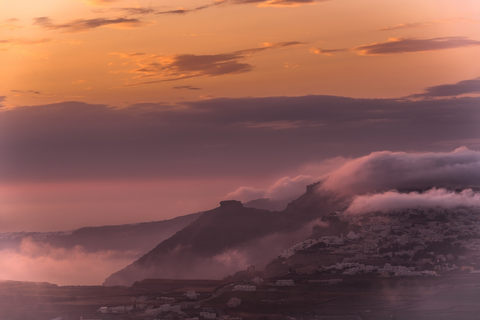
Santorini offers one of the world’s most distinctive environments for growing grapes.
The island’s soils were formed through successive volcanic eruptions and contain layers of ash, pumice, sand and lava. They are poor in organic matter and contain very little clay. These conditions have prevented phylloxera from establishing itself, allowing Santorini to preserve some of the oldest continuously cultivated vines in Greece.
The climate presents an equally demanding set of conditions. Summers are warm and exceptionally dry, rainfall is limited and powerful Aegean winds sweep across the exposed landscape.
The vines survive without irrigation by drawing on moisture retained in the porous volcanic soil from winter rainfall, nighttime humidity, sea mist and morning dew.
The Santorini Kouloura
To protect the vines from the island’s relentless winds and blowing volcanic sand, Santorini’s growers developed the kouloura, a traditional basket-shaped vine-training system.
The vine’s canes are woven into a low, circular basket close to the ground. Grapes grow inside the basket, protected from wind, intense sunlight and airborne sand. The shape also helps capture precious atmospheric moisture.
Creating and maintaining each kouloura requires extensive skill and must be done almost entirely by hand. Although the method contributes to Santorini’s exceptionally low yields, it is essential to the survival of the island’s vines.


Precision in the Vineyard
Estate Argyros works predominantly with old vines, believing they provide the depth, concentration and definition required for its wines.
Vineyard work is meticulous, with each vine treated as an individual organism. Harvest decisions are made parcel by parcel rather than according to a single estate-wide schedule. This allows the winemaking team to select each vineyard at its ideal point of ripeness while preserving the natural acidity for which Santorini is known.
This precision is particularly important with Assyrtiko. The variety can achieve considerable ripeness and structure under Santorini’s intense sun while maintaining remarkable freshness and acidity.

A Minimal-Intervention Approach in the Cellar
The estate’s winemaking philosophy is guided by the character of each vineyard rather than by a fixed formula.
Individual parcels are harvested, fermented and aged separately until late in the production process. This allows the winemaking team to understand each site before deciding how it should contribute to the finished wine.
Purity, definition and balance remain central to the Estate Argyros style. Oak is used selectively, primarily in older, larger French oak vessels. Its purpose is to support and underline the wine’s character, never to overpower or manufacture it.
Patience also plays an important role. Many Estate Argyros wines remain in the cellar for extended periods before release, while its celebrated Vinsanto wines may be aged for many years or even decades.

Sustainability on Santorini
Estate Argyros farms its vineyards organically without pesticides. Most vineyard work is completed manually, with mules traditionally used for ploughing where required.
The vines are not irrigated. Compost made from winemaking by-products, including grape skins and stems, is returned to the vineyards, helping to minimize waste and support the soil naturally.
The estate’s modern winery in Episkopi was also designed to respect Santorini’s landscape while improving environmental and energy efficiency. Its production facilities allow for precise control throughout the winemaking process while supporting the estate’s philosophy of minimal intervention.

The Indigenous Grapes of Santorini
Estate Argyros is dedicated to the varieties that have evolved alongside Santorini’s volcanic landscape.
Assyrtiko leads the estate’s portfolio. Known for its natural acidity, structure, citrus character, saline profile and exceptional ageing ability, it is one of Greece’s most internationally recognized grape varieties.
The estate also works with other indigenous varieties, including Aidani, Athiri and the rare red grape Mavrotragano. Each offers a different expression of the island and contributes to the preservation of Santorini’s viticultural heritage.
Vinsanto, Santorini’s historic naturally sweet wine, is another cornerstone of Estate Argyros. Produced from sun-dried grapes and aged for extended periods, it combines concentration and sweetness with the vibrant acidity that distinguishes the island’s finest wines.
Wines Made to Age
Ageing potential is one of the defining qualities of Estate Argyros wines.
Young Santorini Assyrtiko can offer remarkable clarity, freshness and mineral tension. With bottle age, it can develop greater texture and complexity while retaining its structure and energy.
Because many of the estate’s wines are produced in limited quantities, Estate Argyros publishes a vintage chart to help collectors follow their development. The chart is based largely on bottles stored under controlled conditions at the winery.
Larger formats, such as magnums and jeroboams, generally develop more slowly than standard bottles, while wines stored in warmer conditions may mature more quickly.

Visiting Estate Argyros
Located in Episkopi Gonia and surrounded by vineyards, the Estate Argyros winery covers more than 3,000 square metres.
Although the building includes an elegant and spacious visitor area, its design places the greatest emphasis on wine production. Every stage can be managed with maximum precision and minimal unnecessary intervention.
Visitors can explore the vineyards and production facilities before participating in guided tastings featuring Assyrtiko, indigenous Santorini varieties and the estate’s renowned Vinsanto.
For anyone seeking to understand the wines of Santorini, Estate Argyros offers more than a tasting. It is an introduction to an ancient vineyard, a remarkable volcanic landscape and four generations of dedication to preserving them.